
Quick answer: An answering service for plumbers picks up every call you can’t, day or night, sorts real emergencies from routine requests, and books or dispatches the job so it doesn’t go to the next plumber on Google. You can choose between a live service, which usually costs $135 to $450+ a month for small businesses, and an AI answering service, which starts around $25 to $65 a month. Many shops get the best results from an AI receptionist that hands emergencies to a human.
It’s 9:40 on a Tuesday night. A homeowner is standing in an inch of water, phone in one hand, towel in the other. They call you first. It rings five times and goes to voicemail. They don’t leave a message. Thirty seconds later, they’re talking to your competitor.
You never knew the call happened. That’s what makes missed calls so expensive: they don’t show up anywhere except your competitor’s invoice.
This guide breaks down what a plumbing answering service actually does, what it costs in 2026, how AI answering compares to a live receptionist, and how to choose the right setup for your shop without paying for things you don’t need.
Why missed calls cost plumbers more than almost anyone else
Most businesses lose a sale when they miss a call. Plumbers lose an urgent sale, the kind of job where the customer will hire whoever picks up first.
The data on caller behavior is blunt:
- Most callers won’t leave a voicemail. In an analysis of more than 18 million missed business calls, only 15% of callers left a voicemail. The other 85% hung up.
- Most missed calls never get returned. The same company’s data found that 69% of missed business calls don’t get a callback within 48 hours.
- Customers move on fast. In a CallRail survey of 1,000 U.S. consumers, 78% said they have abandoned a business after an unanswered call.
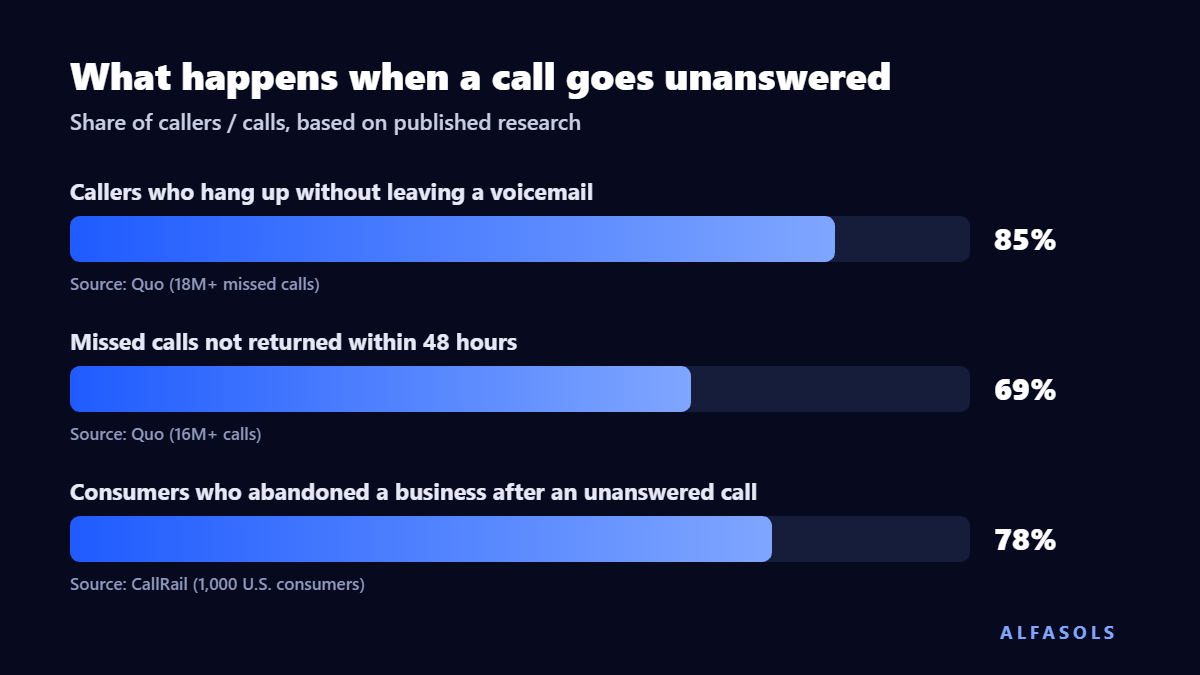
Put those together and the math gets uncomfortable. A missed call is rarely a delayed job. Usually it’s a lost one, and in plumbing, emergency tickets are often your most profitable work.
The plumber’s real problem: your hands are busy
You’re not missing calls because you don’t care. You’re missing them because you’re under a sink, on a ladder, driving between jobs or finally having dinner with your family. A one- or two-truck shop simply can’t answer every call live, and the calls that come in after hours are often the most urgent ones.
That’s the gap an answering service fills.
What a plumbing answering service actually does
A good answering service doesn’t just take messages. Built properly, it acts like a calm, well-trained dispatcher who never takes a day off. For a plumbing business, that means it should:
- Answer every call within a few rings, 24/7, including nights, weekends and holidays.
- Triage emergencies. It should tell the difference between “water is pouring through my ceiling” and “I’d like a quote for a new water heater next month,” and handle each one differently.
- Capture the details you need: name, address, callback number, the problem, how urgent it is and whether the caller is a homeowner, tenant or property manager.
- Book the job or dispatch the on-call tech, following your rules: your service area, your hours and your emergency fee.
- Send you a clean summary by text or email, and ideally straight into your scheduling software (Jobber, Housecall Pro, ServiceTitan or similar).
- Handle the routine questions: “Do you service my area?”, “Do you charge for estimates?”, “Are you licensed and insured?”
If a service can’t do steps 2 and 4, it’s a message-taking service, not an answering service. That difference matters most at 2 a.m.
How much does an answering service for plumbers cost?
Pricing depends on three things: the type of service (live, AI or hybrid), how many calls you get, and how the provider bills (per minute, per call or flat rate).
| Option | Typical monthly cost | Best for |
|---|---|---|
| On-call phone rotation | $0 (but costs you sleep and jobs) | Very small crews with low call volume |
| Live answering service | $135 to $450 for many small-business plans; much more at higher volume | Shops that want a human voice on every call |
| AI answering service / AI receptionist | Roughly $25 to $65 to start, then per call or flat rate | Busy shops that want 24/7 coverage at a low cost |
| Hybrid (AI first, human for emergencies) | Varies by setup | Shops with a lot of after-hours emergency work |
For reference: Housecall Pro, citing a 2026 industry price guide, puts most live answering plans for small businesses at $135 to $450 per month. At higher volume, live plumbing answering from established providers can run about $384 to $1,725 a month at 120 calls. AI options start far lower. Quo, for example, lists its AI answering service at $25 a month for 40 calls, then $1 per additional call.
Watch out for the per-minute trap
Plumbing call volume isn’t steady. It spikes during freezes, storms and holiday weekends, exactly when you most need coverage. Per-minute billing can turn a busy week into a surprise bill. Flat-rate or per-call pricing is usually easier to predict.
The only cost comparison that matters
Don’t compare the service to $0. Compare it to the jobs you’re currently losing. If your average emergency ticket is several hundred dollars and an answering service saves even two or three of those a month, it has usually paid for itself.
Try this quick check: open your phone’s call log for last month, count the missed calls from numbers you don’t recognize, and multiply by your average ticket and your close rate. That’s a rough picture of what voicemail is costing you.
AI answering service vs. live answering service for plumbers
This is the decision most plumbers struggle with. Here’s an honest comparison.
| AI answering service | Live answering service | |
|---|---|---|
| Availability | 24/7, answers instantly, never busy | 24/7 with most providers; hold times can rise during peaks |
| Cost | Low and predictable | Higher; often billed per minute |
| Handling many calls at once | Yes, unlimited simultaneous calls | Depends on staffing |
| Knowledge of your business | Trained on your services, area, prices and rules; consistent every time | Follows a script; quality varies by agent |
| Booking and software integration | Can book directly and update your systems when set up properly | Often takes a message for you to follow up |
| Emotional or complex calls | Good, and improving, but should hand off when it matters | Strongest here |
Our take: for most small and mid-sized plumbing companies, an AI receptionist set up with a clear emergency handoff gives you the best of both. The AI answers every call instantly, handles the routine 80%, and immediately connects true emergencies to your on-call plumber, with all the details already collected.
What to look for before you sign up
Whichever route you choose, put every provider through these questions:
- How do you handle emergencies? Ask them to walk you through exactly what happens when someone calls at 2 a.m. with a burst pipe.
- Can it book directly into my calendar or field service software? If not, you’re just moving the voicemail problem somewhere else.
- How is pricing calculated during a storm week? Get a real number for a high-volume month.
- Can callers reach a real person when they need one? A good AI setup always leaves a path to a human.
- Will it text the caller back if they hang up? A missed call text back recovers the callers who hang up before anyone answers.
- Who sets it up, and who keeps it tuned? Your services, prices and service area change. The script should change with them.
- How are calls recorded and stored? Make sure recordings, consent and data handling are clear and compliant.
An example of what this looks like for a plumbing shop
This is an illustrative example, not a client case study.
Imagine a three-truck residential plumbing company. During the day, the owner and techs answer when they can. After 6 p.m., calls go to voicemail.
With an AI receptionist in place:
- 7:15 p.m.: A caller asks about water heater replacement. The AI answers their questions, confirms they’re in the service area and books an estimate for Thursday morning. The owner gets a text summary.
- 11:48 p.m.: A caller reports water coming through the ceiling. The AI recognizes an emergency, collects the address and details, explains the after-hours fee and connects the call to the on-call plumber.
- 8:02 a.m.: The owner checks one clean list of last night’s calls instead of guessing from a call log full of missed numbers.
No voicemails, no phone tag, and no customer left wondering whether anyone is coming.
How to set up an answering service for your plumbing business
- Write down your rules. Service area, hours, what counts as an emergency, your emergency fee and who’s on call.
- List your top 15 questions callers ask, with your answers.
- Decide what gets booked and what gets transferred. Routine work can be booked; emergencies should reach a human fast.
- Connect your tools: calendar, field service software and where you want call summaries sent.
- Forward your calls. Most setups use simple call forwarding, either after a few rings or after hours, so you keep your existing number.
- Test it like a customer. Call it yourself as a panicked homeowner, a price shopper and a property manager.
- Review calls weekly for the first month and tighten the script.
The bottom line
You don’t need more leads if you’re losing the ones that already call you. An answering service, especially a well-built AI receptionist with an emergency handoff, closes that leak for less than the cost of a single lost job each month.
At Alfasols, we build and manage AI receptionists for service businesses: trained on your services, your service area and your emergency rules, connected to the tools you already use, and tuned over time. If you’d like to hear how one would handle your calls, book a free call and we’ll walk you through it, with no pressure and no jargon.
Frequently asked questions
What is an answering service for plumbers?
It’s a service, staffed by people, AI or both, that answers your business calls when you can’t. It captures caller details, triages emergencies, and books jobs or dispatches your on-call plumber so you don’t lose customers to voicemail.
How much does a plumbing answering service cost?
Live answering services typically cost $135 to $450 or more a month for small businesses, rising with call volume. AI answering services usually start around $25 to $65 a month. The right comparison is cost versus the jobs you’re currently losing to missed calls.
Can an AI answering service handle plumbing emergencies?
Yes, if it’s set up properly. A well-configured AI receptionist can recognize emergency language like “burst pipe,” “flooding” or “no water,” collect the details and immediately transfer the call or alert your on-call plumber.
Will customers know they’re talking to AI?
Modern AI receptionists sound natural, but we recommend being transparent. Most callers care far more about getting a fast, helpful answer than about who or what picks up. A good setup always lets callers reach a person when they need one.
Do I have to change my phone number?
No. Most answering services work through call forwarding, so you keep your current business number and choose when calls are forwarded, for example after four rings or after business hours.
Is an answering service worth it for a one-truck plumber?
Often, yes. Solo plumbers miss the most calls because they’re always on a job. Even recovering one or two jobs a month usually covers the cost of an AI answering service.